Dambulla's five caves are stacked with painted ceilings, more than 150 Buddha statues, and walls set right into the granite. It's a lot to take in. The trade-off is light: these caves are dark, a lot of interesting subjects are hidden in the shadows, and a row of halogen lamps blows out patches while the rest stays black. Space is tight too, so a fast wide lens does most of the heavy lifting. Then there's the climb, a brutal stack of steps in real heat with your kit on your back. Still worth going? Every time, and here's why.
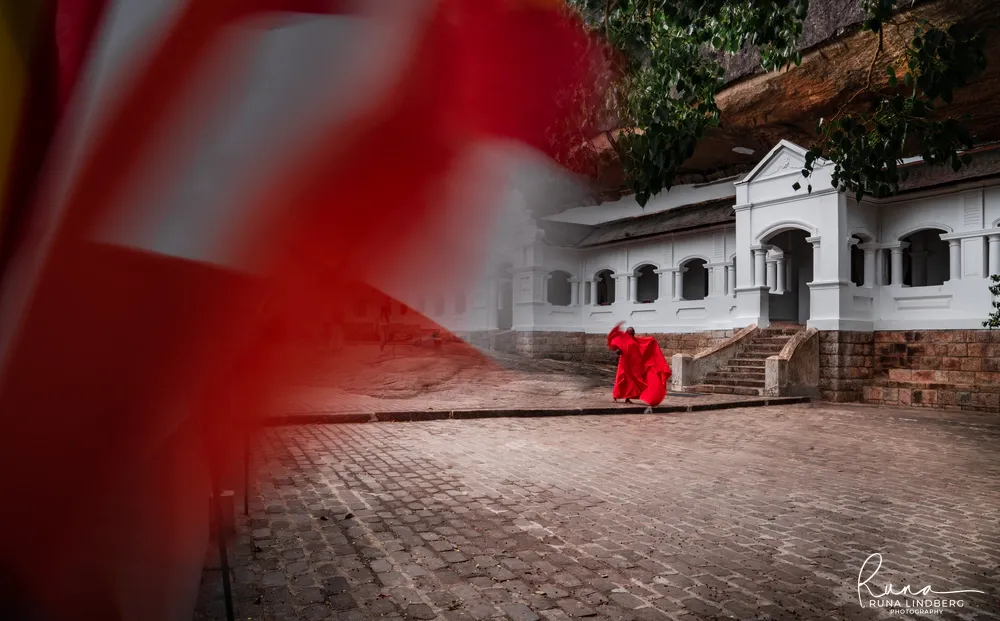
A monk in red robes crossing the temple courtyard at Dambulla, a prayer flag blurred in the foreground
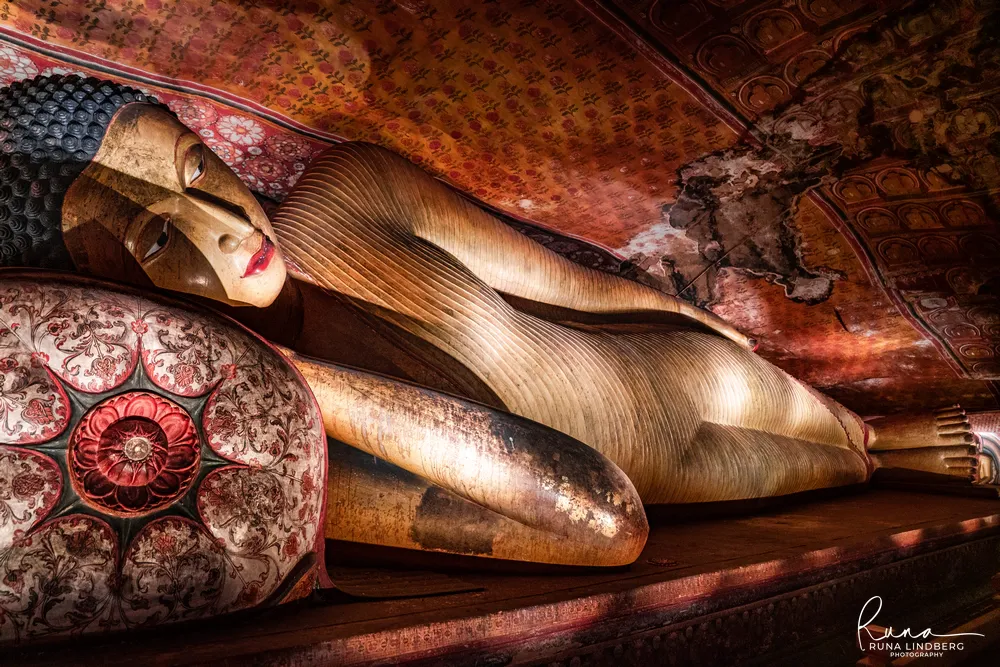
A reclining Buddha in a dark cave at Dambulla, a shaft of light catching the red-painted soles of its feet
Jump to:
Dambulla is the biggest and best-kept cave temple in Sri Lanka, sitting on top of a lone slab of granite. Inside, five linked caves hold over 150 Buddha statues, every size, every posture. Kings and gods turn up too, but the ceilings and walls steal the show. Every inch is painted, story upon story, and it doesn't let up. And this is no museum piece. Monks still use these caves for prayer and ceremony, and someone has dressed the statues in fresh flowers and petals, which is what makes the place feel alive rather than preserved.
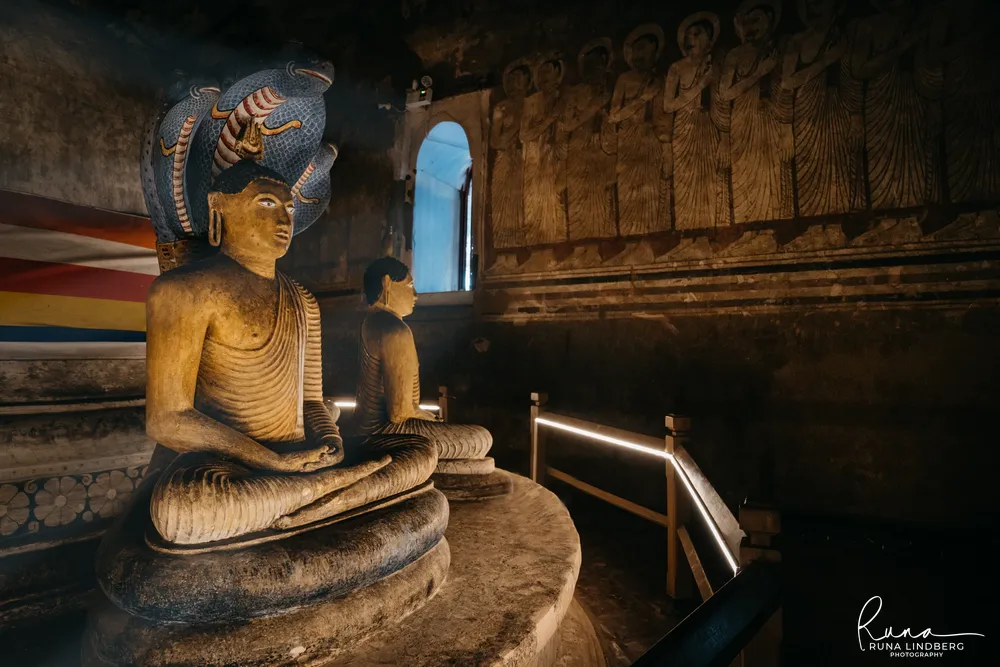
Seated Buddha sheltered by a multi-headed cobra hood in a dark cave shrine at Dambulla, lit by a small arched window
Longer than it looks. The rock is barely a five-minute walk from town, easy enough to reach on foot or by tuk-tuk. The stairs are where it gets you. There's no lift, no back way in, just 364 steep steps in subtropical heat. The view is your reward before you even reach the top: the path keeps opening onto the green flatlands below, so stop, breathe, and take a few frames while you're at it.
One thing to watch. The monkeys on the path are quick and they know exactly what they're doing. Bags, sunglasses, anything loose, they'll have it off you from the branches before you clock what happened. Keep your gear zipped and close.
Crowds probably won't be your problem. The temple is famous, but the day I went it was near empty. Other travellers say it's a different story on weekends and religious holidays, when the buses roll in with pilgrims and tour groups. Check a calendar before you commit to a date.
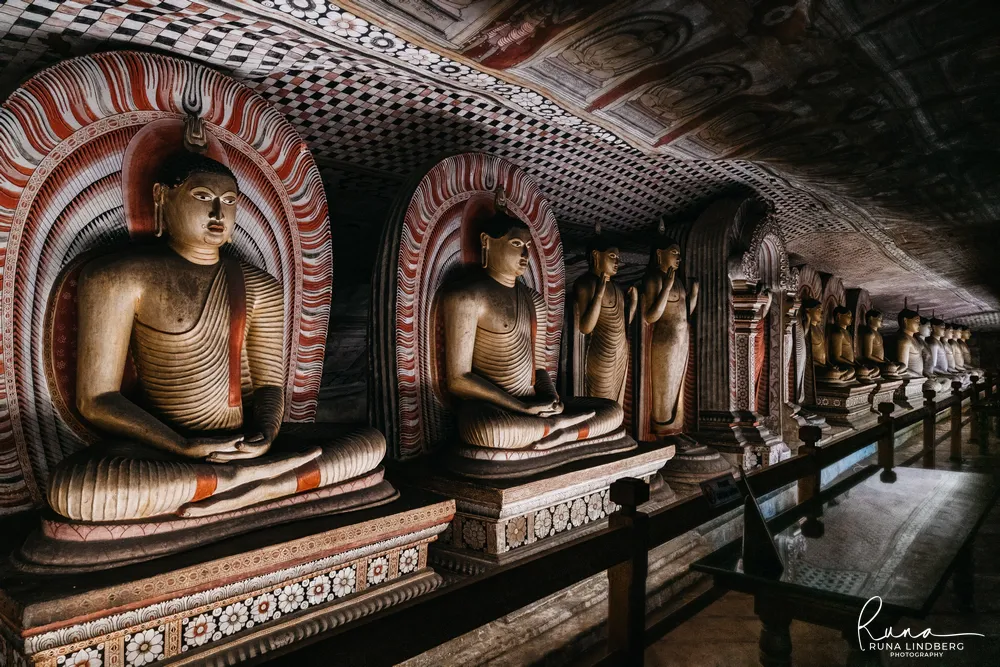
A long receding row of seated Buddha statues under a fully painted ceiling at Dambulla, each framed by a red and white arch
This is where Dambulla pays you back. A few things jump out for photographers.
Start with the ceilings, because most people walk in and never look up. They're painted corner to corner, patterns and figures that are centuries old, and they work two ways: tight for the detail, or as a backdrop behind the statues below. Slow down and compose. The caves throw a lot at you at once, so pick a subject, circle it, shoot it from three or four angles before you move on.
Then the statues. More than 150 of them, packed into the rock at every scale, which gives you repetition and layers to play with. Put one sharp in front and let a row of others fall away behind it.
Light is the running battle. It's dark, and what little you get pours in through the mouths of the caves. Don't fight that. The dark is the mood, so shoot for it instead of trying to lift it.
Step back outside and there's just as much. Pilgrims in white and saffron carrying offerings. Shrines piled with flowers and oil lamps. Flags snapping in the wind, a lotus pond, white temple walls hard against grey stone, monks in their robes.
Fair warning from my trip: they were restoring part of the temple while I was there, and scaffolding covered a few of the caves, which cost me some shots. This stuff comes and goes. It might be long finished by the time you arrive, or you might get unlucky like I did.
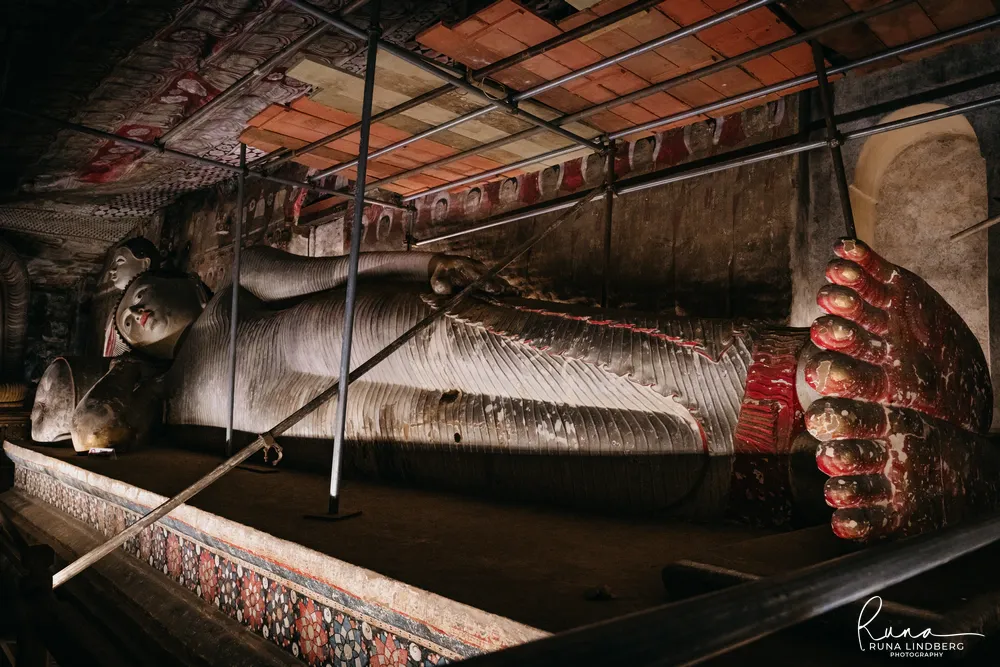
A large reclining Buddha behind restoration scaffolding at Dambulla, the soles of its feet painted red
The wider site runs to more than 80 recorded caves, but the bit you actually visit is a line of five, tucked under one big rock overhang and closed off with white walls. Between them, as I said, roughly 150 statues and more paintings than you can count.
Quick tour of what's in each:
Cave 1, Devaraja Viharaya (Cave of the Divine King): More or less one giant statue and not much room for anything else. A 14-metre reclining Buddha, carved straight out of the cave's own granite, caught in the moment of passing into parinirvana. His disciple Ananda sits at his feet, and Vishnu, the god the cave is dedicated to, stands nearby. The oldest paintings have gone almost black with candle soot, so don't expect to see much of them.
Cave 2, Maharaja Viharaya (Cave of the Great Kings): The big one, and the best. Around 52 metres across and 7 high. Over 50 Buddhas sitting, standing, lying down, with life-size wooden statues of two kings among them: Vattagamani Abhaya, who founded the place in the first century BC, and Nissanka Malla. The whole ceiling is painted and it hugs the shape of the rock. There's a spring in here too, dripping water that appears to run uphill into its own basin.
Cave 3, Maha Aluth Viharaya (Great New Monastery): Done up in the 18th century in the Kandy style, so it reads more like a state hall than a cave. Fifty Buddhas, a big meditating one shielded by a snake, and a statue of the king who built it, Kirti Sri Rajasinghe. The yellows and reds on the walls and ceiling are strong. Like Cave 1, it's good for detail and portraits.
Cave 4, Paccima Viharaya (Western Cave): Small and close. A stupa in the middle, cracked open by treasure hunters at some point, with seated Buddhas around it. Darker than the rest, and the wall paintings are fine enough that they reward you for standing still a while.
Cave 5, Devana Alut Viharaya (Second New Cave): The newcomer, brick and plaster, finished in the early 1900s. Another reclining Buddha, about 10 metres, and a crowd of standing figures. The interesting part is the crossover: Hindu gods like Vishnu, Kataragama, and the local Devata Bandara standing shoulder to shoulder with the Buddhist statues.
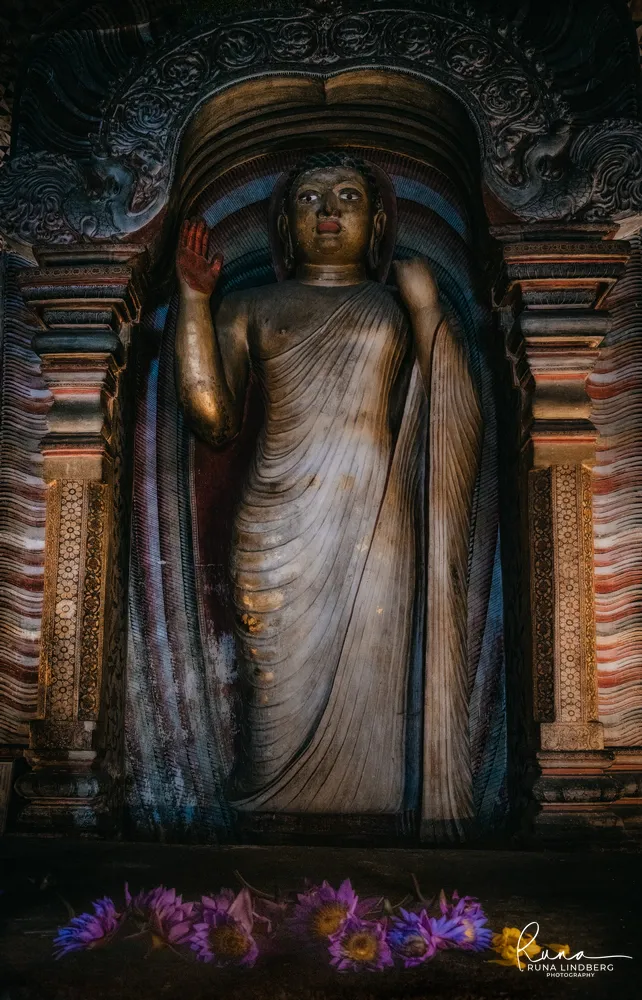
Standing Buddha in the Abhaya Mudra under a carved Makara Torana arch in Cave II (Maharaja Viharaya), Dambulla, Sri Lanka.
Short version: a fast, ultra-wide prime under 24 mm, on a body you trust when the ISO climbs. Everything else is a compromise in here.
I went in with a Sony Alpha 7R III, a 50 mm, and a 24-70 zoom. The 50 was for detail whenever I had space to back up; the 24-70 came out the second the 50 felt boxed in. Both ran out of road in the caves. In the tightest chambers I was pressed so close to the wall that even 24 mm couldn't take it all in, and where the frame did fit, the lens just wasn't fast enough for the darkest corners. In the end my DJI action cam and my phone saved a few frames the big camera couldn't reach. Next time I'm bringing a 20 mm, or something wider still.
A word on tripods. No flash allowed, and the only real light is spilling in from the entrances, so anything that steadies the camera earns its place. Full tripods are fine as long as you're not blocking the pilgrims, but good luck setting one up in those narrow chambers without becoming an obstacle. A monopod is easier, or a small clamp if you fix it carefully and keep it well away from any statue or painted surface. I skipped the tripod entirely and leaned on high ISO and a steady hand, and it was fine.
What to pack:
These are working Buddhist shrines, and the rules at the door aren't negotiable:
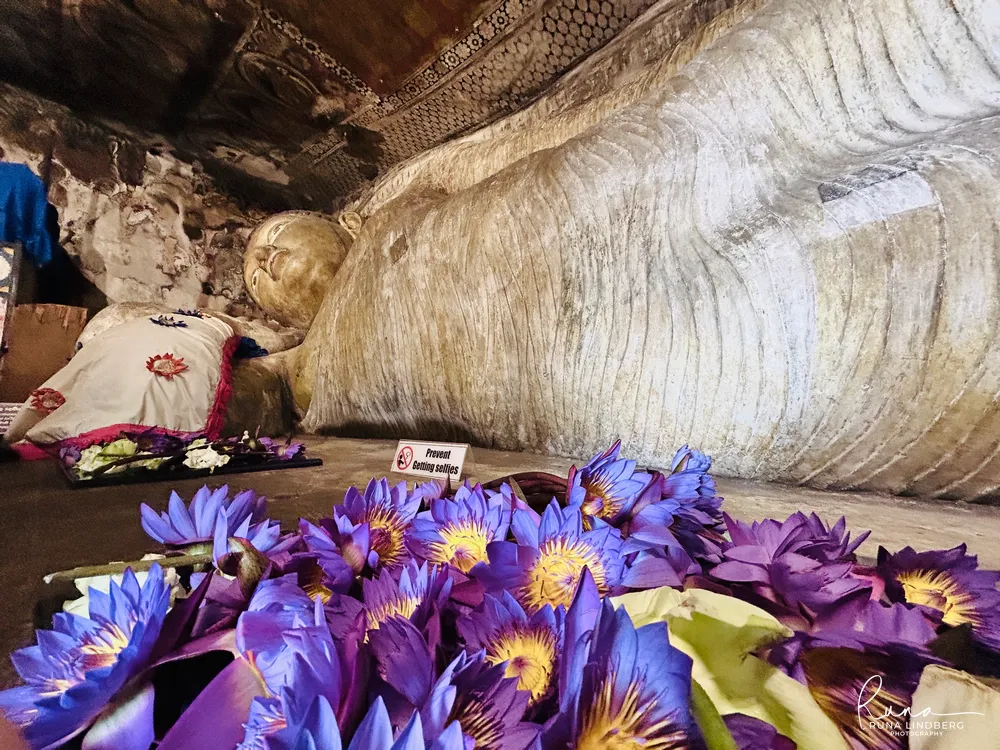
Blue water lily (Nil Manel) offerings placed before a Buddha statue in Devaraja Lena, the first cave at Dambulla, Sri Lanka.
Dambulla sits dead centre on the island, so it's an easy run from Kandy or Sigiriya. Sigiriya is a quick hop; Kandy is more like 2 to 3 hours. Buses come into Dambulla town, and from there it's a tuk-tuk or a short walk to the temple.
When to go: Right at opening, around 7 am, or from mid-afternoon, say 3:30 pm, the caves are quietest and the hot stone is kindest on bare feet. Doors are open roughly 7 am to 7 pm, but the ticket counter shuts before that, so don't cut it fine.
Foreigners pay around 10 euros for the caves, cash only, at a counter down at the base of the rock. The catch isn't the price. It's the system.
There are two counters, and they are not the same. The real one, for the caves, is off to the side at the rear car park, marked Dambulla Cave New Car Park. Over by the giant Golden Buddha there's a second office, the Central Cultural Fund, and that one sells combined Cultural Triangle tickets and entry to places like Sigiriya. A Sigiriya ticket alone is about 35 USD, so grabbing the wrong one is an expensive mistake, and nothing in the signage tells you which is which.
Which is how I ended up holding the pricey one. The signs made no sense, the guy behind the counter had no English, and card payment wasn't happening. So: bring cash, aim for the rear car park counter, and don't get sold a combo ticket unless you're actually doing Sigiriya or the rest of the Cultural Triangle that day.
Day trip, no question. I wouldn't sleep in Dambulla town again, because once you take away the temple there's not much left. It's a junction, basically. The food is thin and pretty plain, nothing close to what you'd find in Galle, Mirissa, or Kandy, and the evening empties out fast once you've done the caves. Base yourself in Sigiriya or Kandy and come over for the day.
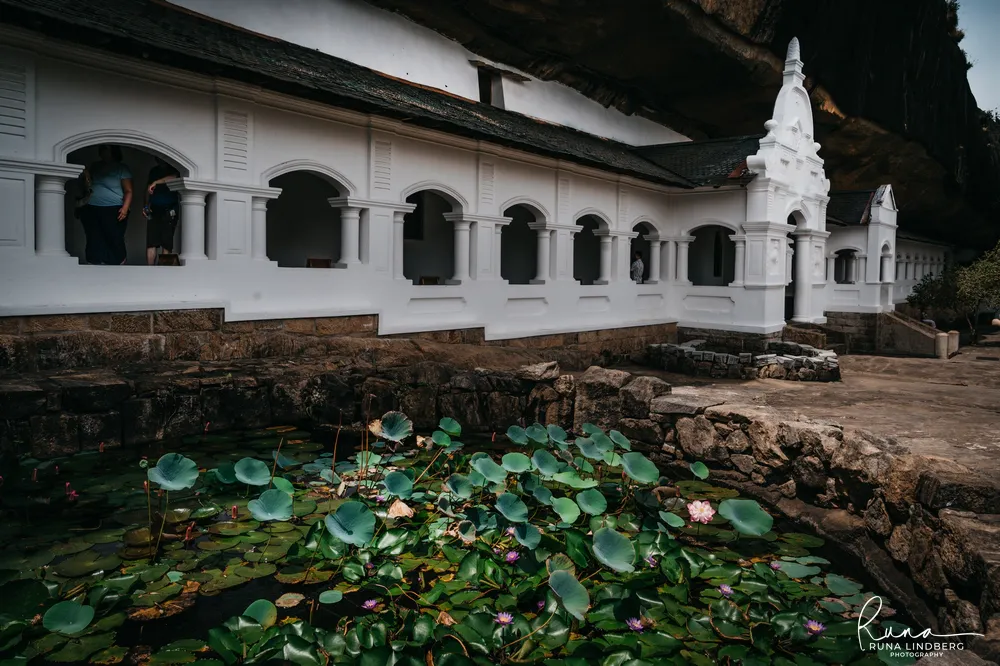
The white colonnaded temple facade under the rock overhang at Dambulla, with a lily pond in the foreground
Dambulla is a stop on "Sri Lanka: Empowering Her Lens", a Beyond Taj Tours trip set for August 2027. It's a women-only tour built for beginners, the kind of group where you can find your feet at your own speed without anyone rushing you. The whole point is a safe, respectful space to try things and get them wrong. We work on three fronts at once: the seeing and composing side of it, the nerve to shoot in public and walk up to strangers, and the technical craft, one piece at a time, no pressure.
You don't need your own camera. We can lend you a body and gear on request, and every age is welcome.
Worth knowing: the mentors and the guides are all women.
The route is designed by Beyond Taj Tours and run through our licensed travel partner, Orange DMC.
If any of that sounds like you, have a look at the details here or email us, no strings attached.
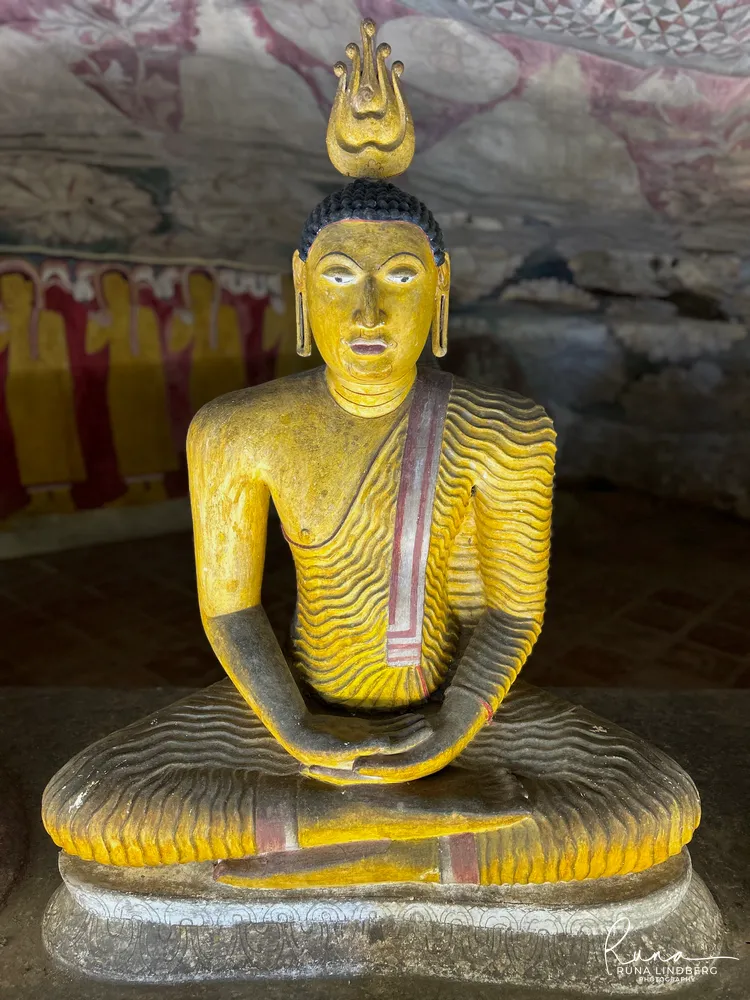
A single seated Buddha in meditation with a flame finial, painted in ochre with wavy robe folds, at Dambulla
Photographic potential: ★★★★☆ (4/5). Those ceilings and that crush of statues give you frames you won't get anywhere else on the island. The downside is that Dambulla is the one site, so you'll have shot it in two or three hours, and the scaffolding across half the caves knocked the shine off my visit.
Accessibility: ★★★☆☆ (3/5). The climb is hard work, the caves are dark and cramped, and pulling a clean frame out of that light takes some doing.
Value for money: ★★★☆☆ (3/5). Ten euros for the caves is fair for what you get. The problem is the ticket setup that tempts you into overpaying, plus a town with little going for it. Right ticket, right prep, and it's money well spent.
Come with a proper wide lens first thing in the morning and Dambulla is worth every step. Come with a kit zoom at noon and you'll leave a bit deflated.
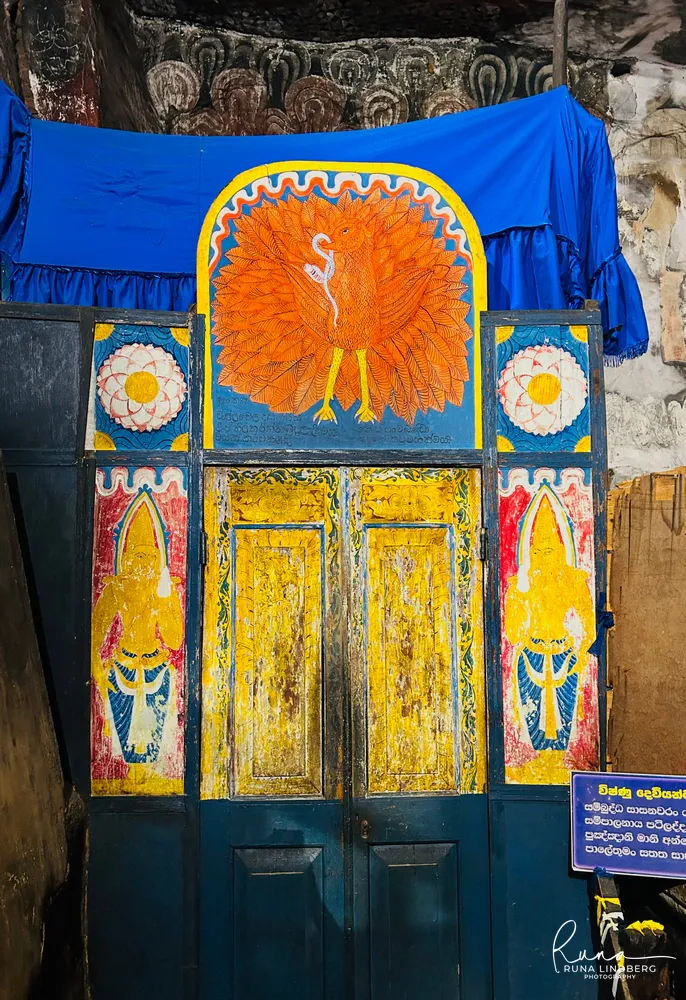
Painted wooden shrine doors at Dambulla topped by an orange peacock, with deity figures on the side panels
Is Dambulla Cave Temple worth it for photographers? Yes, if you bring the right lens. Five caves, 150-plus Buddhas, and painted ceilings that go back centuries, all of it good for detail and interior work. Just know going in that the light is weak and the space is tight.
What camera gear should you bring? A fast wide-angle under 24 mm, around 20 mm is the sweet spot, on a body you trust at high ISO. You need genuine width to fit those big statues into small caves. No flash and barely any light, so bring a monopod to steady things, it handles better than a tripod in the narrow rooms. Keep an action cam or your phone on you as a second option for the widest frames.
What's the dress code and the photo rules inside? Shoulders and knees covered or you don't get in. Shoes off at the door. Never put your back to a Buddha for a photo, and absolutely no flash.
Where can you grab a drink or a snack? Down at the car park. A few small kiosks sell water, soft drinks, and light snacks, enough to refuel before the climb or after it. Don't go looking for anywhere air-conditioned to sit, though. It's open-air stalls and nothing more.
Runa Isabel Lindberg is a writer and passionate photographer whose work has been exhibited internationally. She has been travelling through India, Nepal, Sri Lanka and Indo-China since 2008, and photography has been the thread through all of it. This blog is her personal editorial project: first-hand field notes, honest reviews of the heritage hotels she has stayed in, and photographs taken through her own lens over many return visits.
Follow her personal photography on Instagram: @runa_lindberg
Tours and bookings: the photo tours featured on this site are designed by Beyond Taj Tours, with itineraries curated together with award-winning photographers. All bookings, payments and travel arrangements are handled by our travel partner, Orange DMC, a licensed destination management company based in India. Follow Beyond Taj Tours on Instagram: @beyondtaj.tours
© 2026 Runa Isabel Lindberg. Text and photography by the author, all rights reserved. Site and brand development by Credio Digital Media.
17 Sep 2026

05 Sep 2026
31 Aug 2026
15 Aug 2026
15 Jul 2026
19 Mar 2026
12 Feb 2026
15 Jan 2026
28 Dec 2025
01 Dec 2025
13 Nov 2025