Gajan is a vibrant festival dedicated to Lord Shiva, celebrated across West Bengal, where villagers from all walks of life embrace rigorous ascetic vows; binding themselves to prolonged fasting, intricate body and face painting, and deeply immersive ritual performances. Followed chronologically from Gangatikuri through Kandi to Murshidabad and Cossimbazar, it offers photographers raw emotion, sacred performance, and dramatic low-light scenes, far off the standard tourist trail.
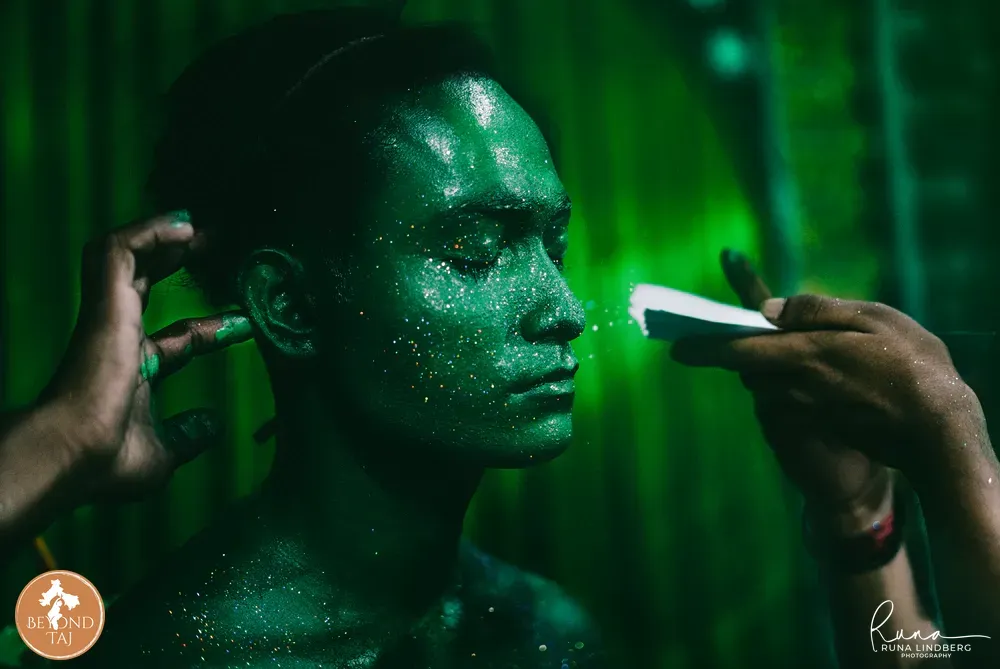
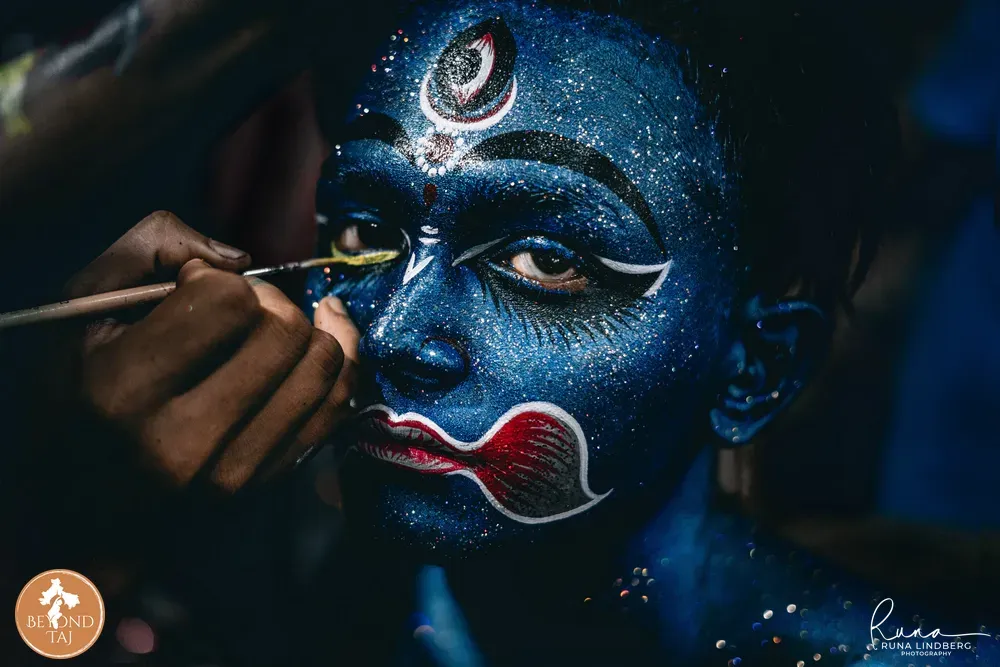
A devotee gets intricate facial painting as he starts transforming to resemble a deity or demon. Cossimbazar, West Bengal
Jump to:
The transition from the quiet lanes of Murshidabad into the active Gajan festival zones is electric. We had already spent our first day in Murshidabad itself, visiting temples and watching early preparations, before driving out the next morning into lush, green village landscapes thrumming with drums, incense and communities deep in ancient rites.
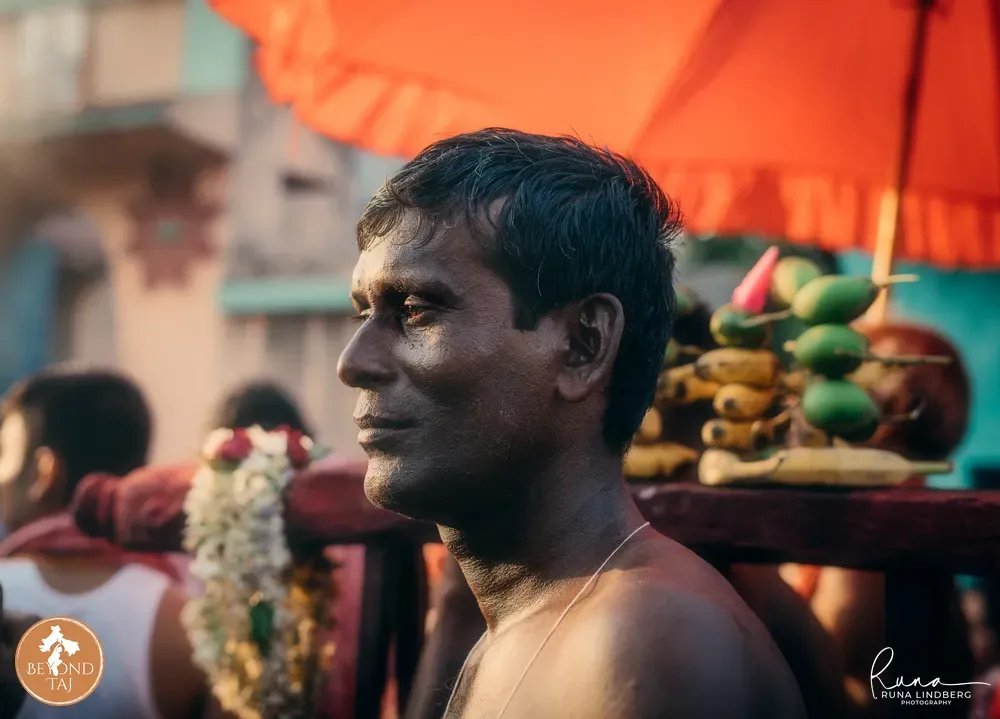
A devotee carries a palanquin with an idol, decorated with flowers and fruits. Gangatikuri.
The first thing that struck us in Gangatikuri wasn't the ritual, it was the welcome. Word travels fast when two foreigners turn up in a village that, according to local elders, had not seen outsiders since the colonial era, and within minutes we had more or less been adopted by the village head. He turned out to descend from the old zamindar family that once ruled here. Their rajbari is long gone, only the temple complex remains, and he spent the day walking us through both, clearly delighted to have an audience for a tradition he cared about.
There is no commercialism here. Travelling through remote rural pockets like Kandi and Gangatikuri alongside an Australian photographer and filmmaker friend, we were the only outsiders present at every stop. This is an organic festival held by believers, for believers. As an outsider your presence is an exception, which makes real respect, cultural humility and genuine curiosity your best credentials. Show interest, and local communities respond with real warmth.
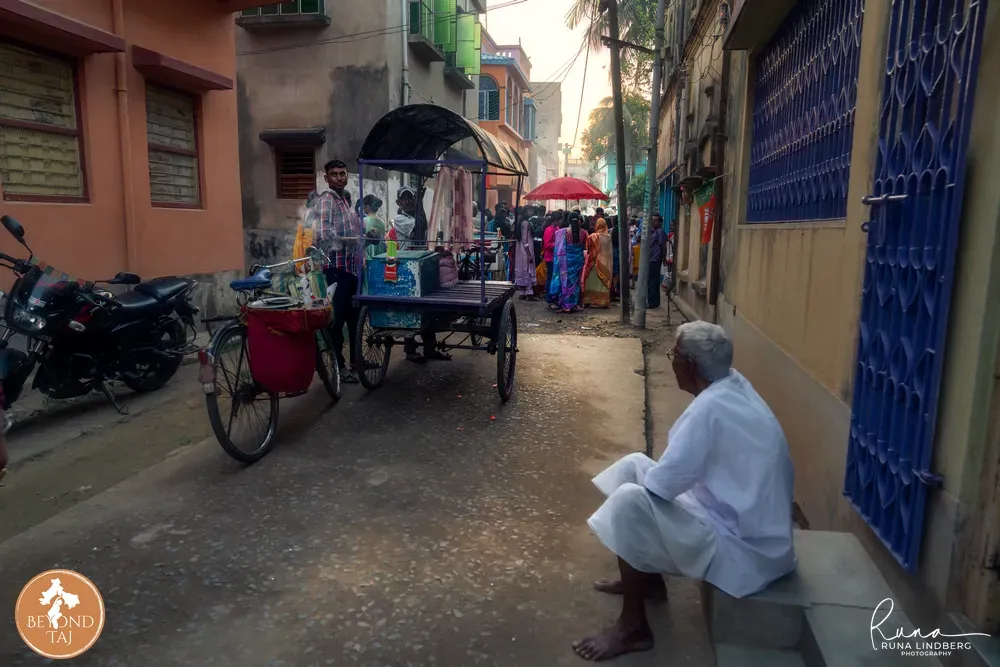
Devotees gather in the streets of Gangatikuri.
While Gajan is celebrated widely across Bengal, following the festival chronologically offers a rewarding narrative arc, and reveals a real diversity of regional rituals.
From the divine impersonations and facepaintings in Gangatikuri on day one, through the raw, archaic asceticism and skull dances in Kandi on the following day, to the climax of Charak Puja and heritage palace stays in Murshidabad and Cossimbazar at the end, it is a layered photographic journey where history, architecture and living faith collide.
There is no single base that covers the whole route comfortably, so plan to move partway through. Berhampore works as a practical anchor for the earlier days, close enough to reach both Gangatikuri and Kandi by car within a couple of hours. For the final days, base yourself in or around Cossimbazar instead, ideally inside a heritage stay like the Cossimbazar Palace of the Roys, which puts you inside the same walls that host the crowds for Charak Puja outside.
Fly into Bagdogra, convenient if you are combining the trip with Darjeeling, or into Kolkata. Both work equally well for reaching Murshidabad district.
From either airport, continue by train to Malda or Berhampore, a genuinely comfortable ride in a first-class carriage and one of the more scenic legs of the trip. From there, a private car and driver are essential. Ours had already driven us on previous trips through the region, and that local knowledge, of the roads and increasingly of us, made a real difference. Build in some slack for police checkpoints along the way, especially if your visit falls close to a West Bengal state election, when checks can slow every route through the district.
Opening the festival journey, Gangatikuri offers a striking introduction to the fine arts of the festival: elaborate costuming and detailed facepainting.
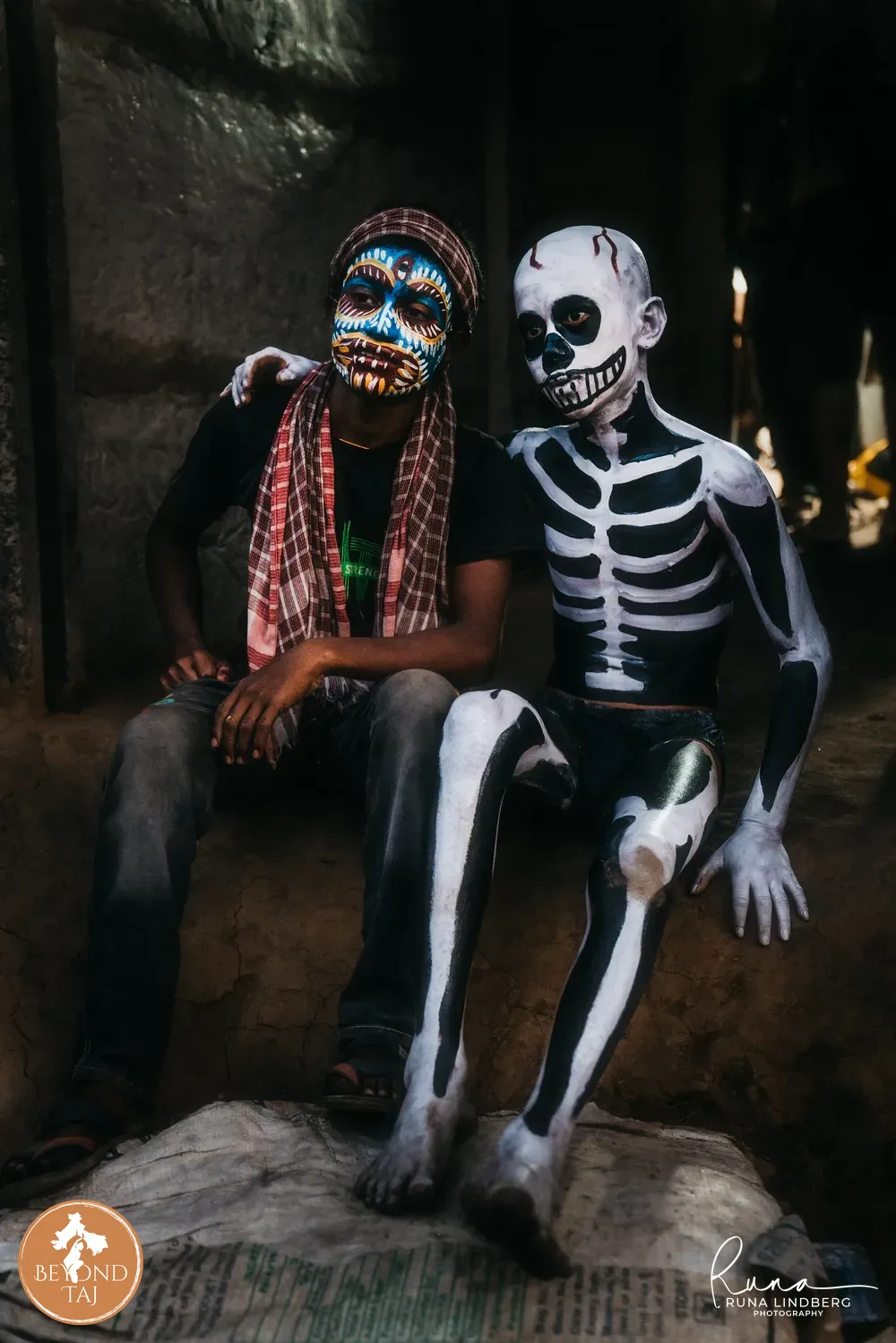
Skeleton and spirit; two of the ganas said to accompany Shiva. Gangatikuri, West Bengal
In Gangatikuri, dancers transform themselves into various deities through finely detailed facial art and vibrant traditional attire. For a portrait and detail photographer, this is paradise. The intricate patterns painted onto the skin tell mythological stories, and the performers enact traditional narratives with careful, deliberate movement.
What surprised me most was learning that the artists use real acrylic paint rather than theatre makeup, applied over the whole body, including on children performing as tiny skeletons and spirit-companions of Shiva. Coming from Germany, where paint used on skin is tightly regulated, that took some getting used to. Photographically, it means properly saturated, vivid colour rather than the flatter look stage makeup often gives.
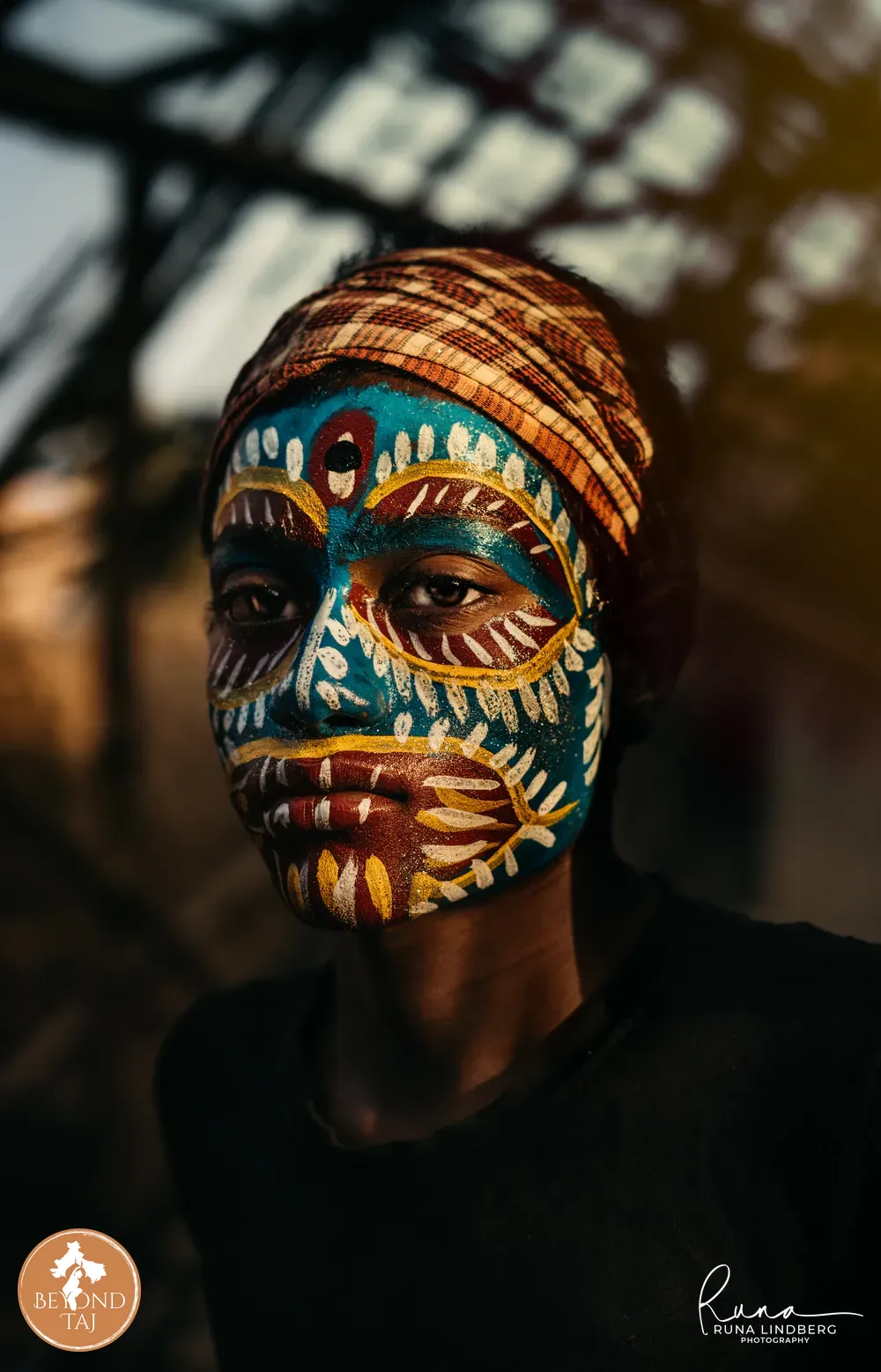
Photographic approach: Take your time here. Use a fast prime lens (such as a 35mm or 50mm f/1.4 or an 85mm portrait lens) to isolate the rich textures of the paint, the gleam of traditional ornaments and the expressive eyes of the performers in the soft ambient light.
We reached Kandi in the early afternoon and were taken in again, this time by the temple priest at the Baba Rudradev Temple. He showed us not only the temple itself but the large surrounding complex, apparently once part of an old rajbari, plus a second rajbari nearby.
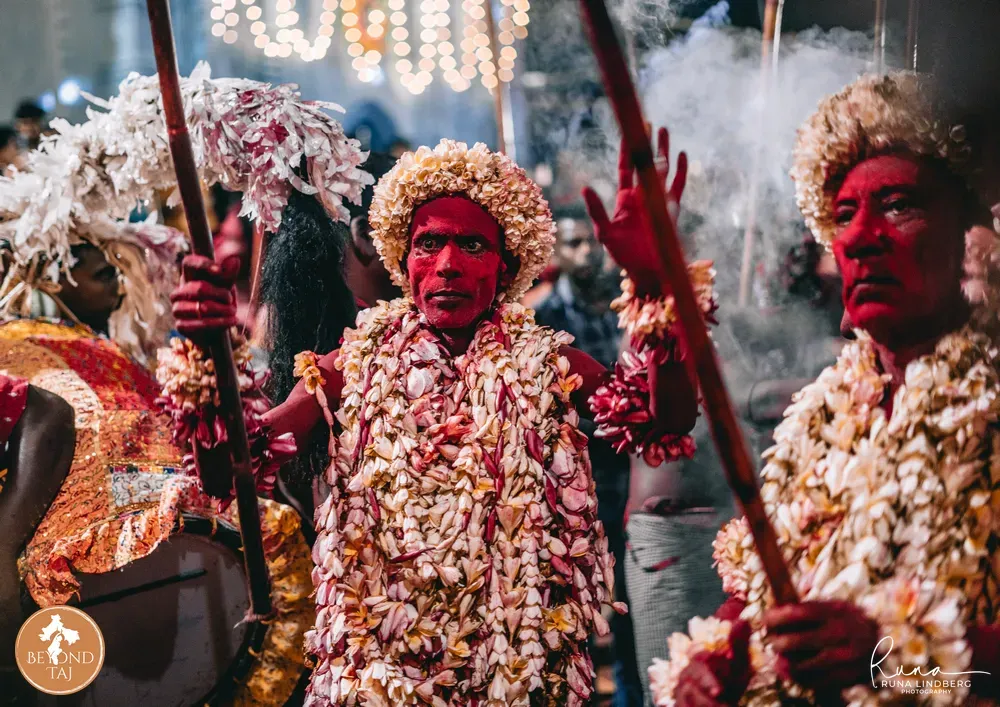
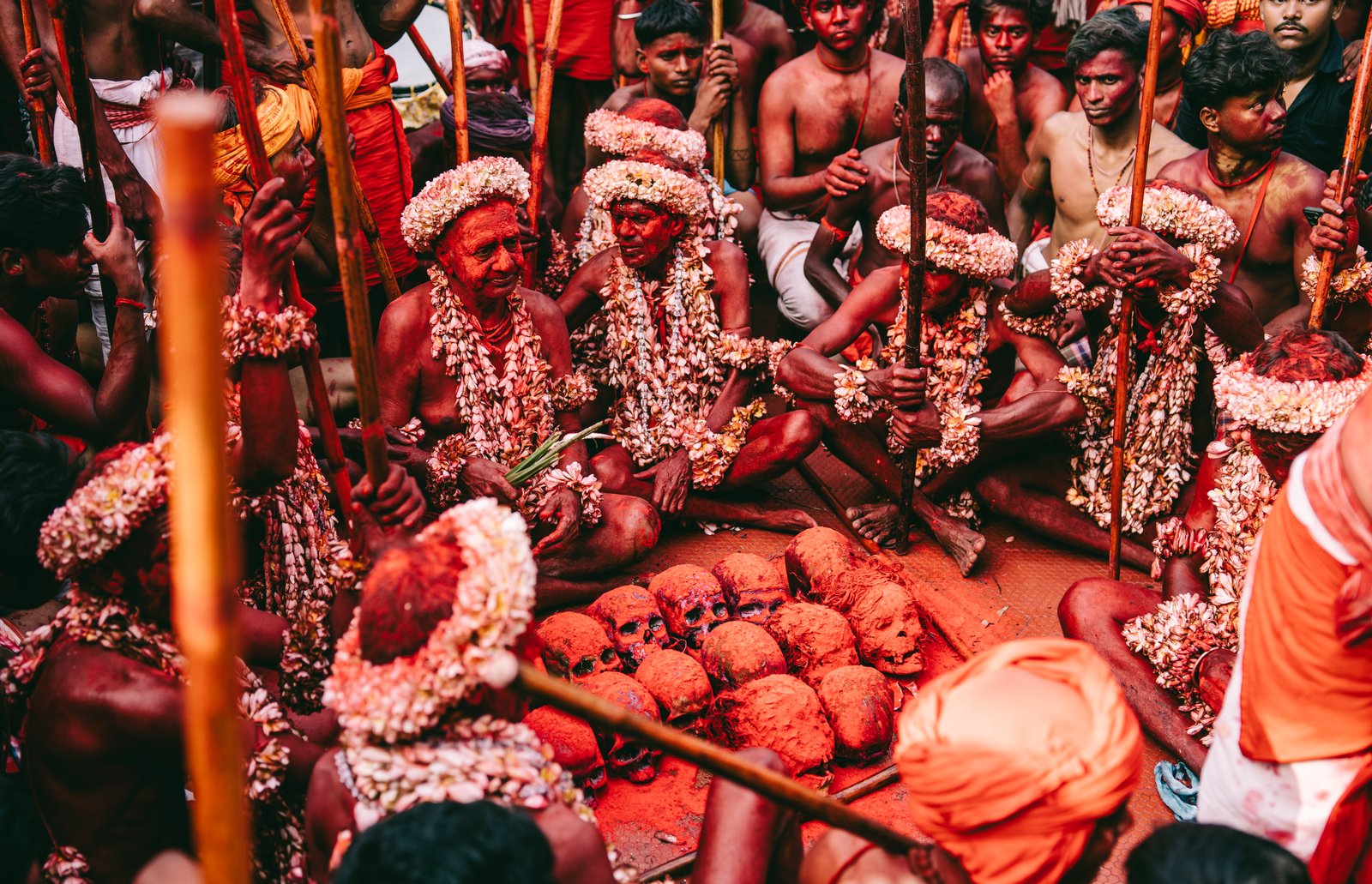
A devotee dances himself into trance at the temple in Kandi, decorated with flowers and red powder.
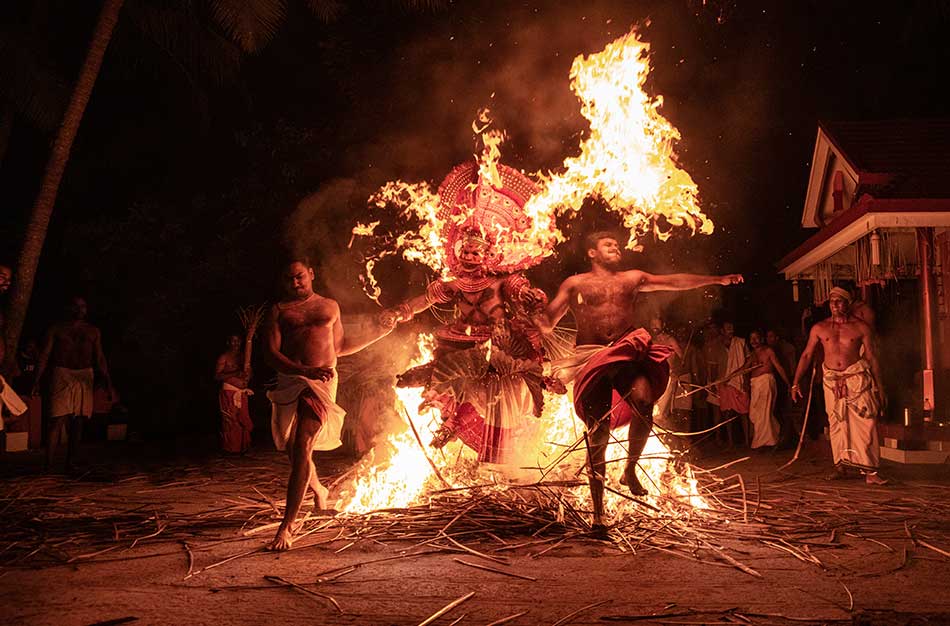
As evening fell, the first ceremonies began: devotional fire dances and ritual washing at the large pond in the centre of Kandi. Alongside this you will see Ban Fora (body and tongue piercings), where participants undergo ritual piercings as acts of surrender.
We went back to the temple after dark and were adopted a second time, by a local photographer who invited us to his parents' house nearby, one of the warmest encounters of the whole trip. He explained how the night tends to unfold, though, like most things at Gajan, on no fixed schedule: devotees gather at the temple late at night, then head out to the cemeteries only once it starts getting light, to dig up the skulls for the Mora Khuli Nach, the Skull Dance. They return with faces covered in red powder and draped in flower garlands, but exactly when varies a lot from year to year. In our year, 2026, that was closer to 8 in the morning. Other years, locals told us, the dancers have shown up considerably earlier.
Here is the honest part. We waited, but by the middle of the night, worn out after two full days of shooting, we gave up and drove back to sleep, and missed the skull dance itself. If you take one piece of practical advice from this guide, it is this: stay only until late evening, go back and rest properly, then return early and be ready to wait well into the morning. There is no reliable hour to plan around here, and trying to power through the whole night in one stretch is the easiest way to burn out before the moment you came for actually happens.
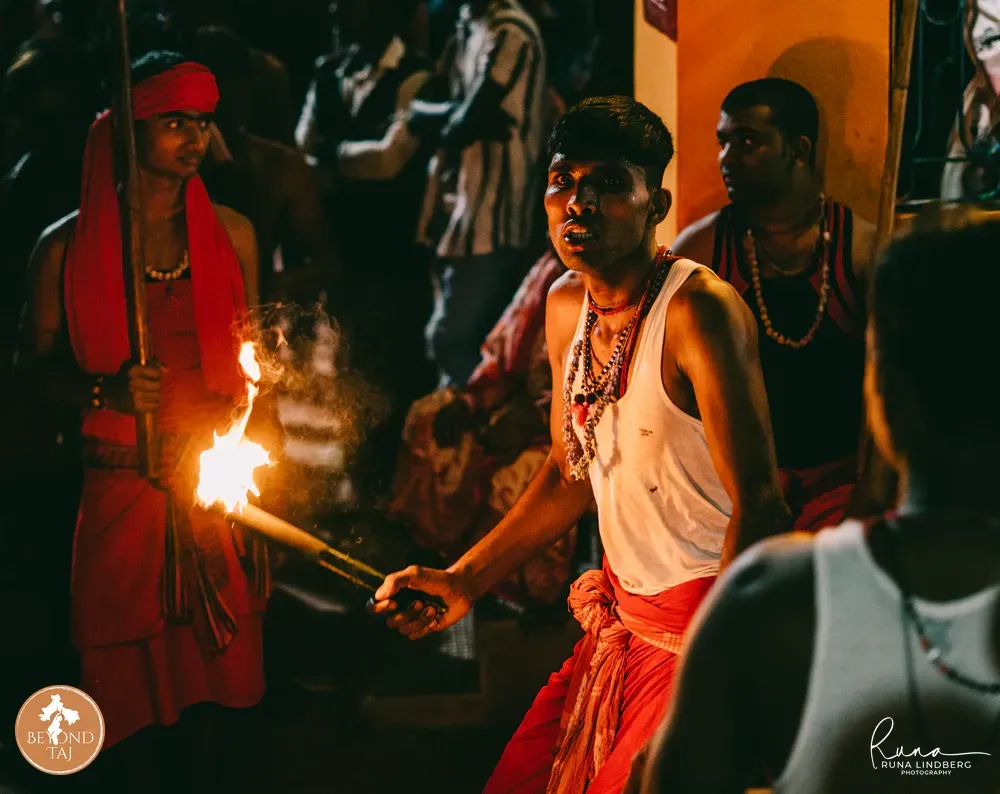
Torch lit, the fire-breather waits for his moment. Kandi.
Photographic approach: These moments require real respect, patience and a steady hand. Keep your distance, use a telephoto lens to capture unposed emotional intensity without invading personal space, and always ask politely before taking close portraits.
Reaching the final days of the festival, the journey centres on Murshidabad and Cossimbazar. Staying at the Cossimbazar Palace of the Roys was, as on previous visits, wonderful, and this time we were upgraded to a room overlooking the garden and an inner courtyard where an old horse carriage still stands. Mr. Roy gave up a good part of his day to walk us through Murshidabad's history, and then helped arrange something we would never have found on our own: a visit to a private atelier in Cossimbazar where craftsmen usually paint the idols for local worship, but where, in the run-up to Charak Puja, they also paint the performers who parade through Murshidabad's streets as gods and demons. One of the artists invited us to eat almost as soon as we arrived, and we were free to move around the workshop as we liked while they worked.
Over the five days we spent in the area, Mr. Roy also opened doors to several other ceremonies beyond Charak Puja itself, various smaller pujas whose individual names I never quite caught, and, most memorably, one performed inside his own family's house temple.
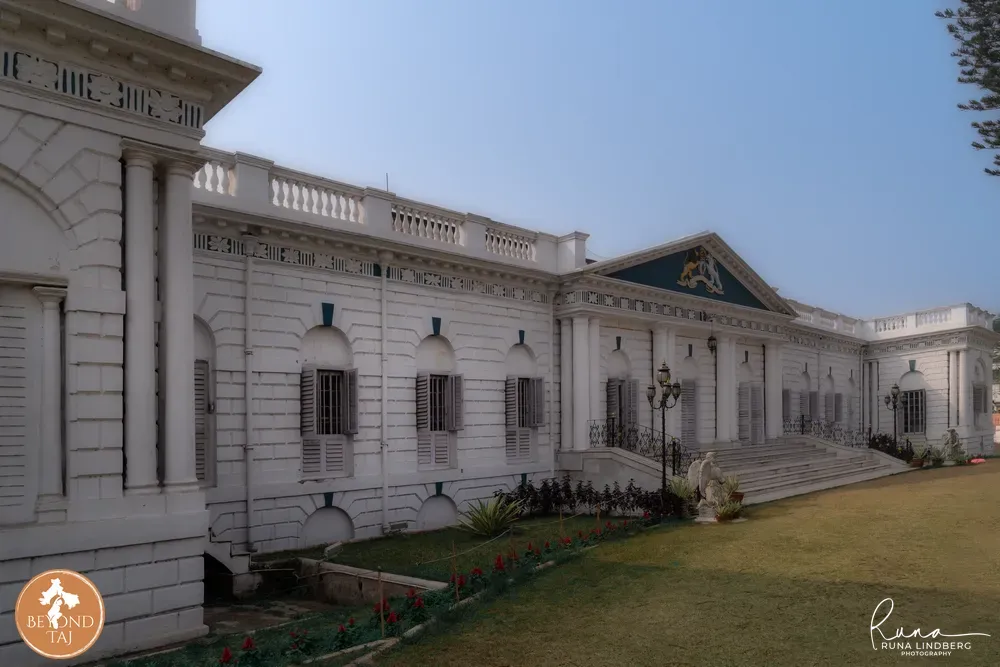
The Palace of the Roys: a stately retreat beside the festival grounds.
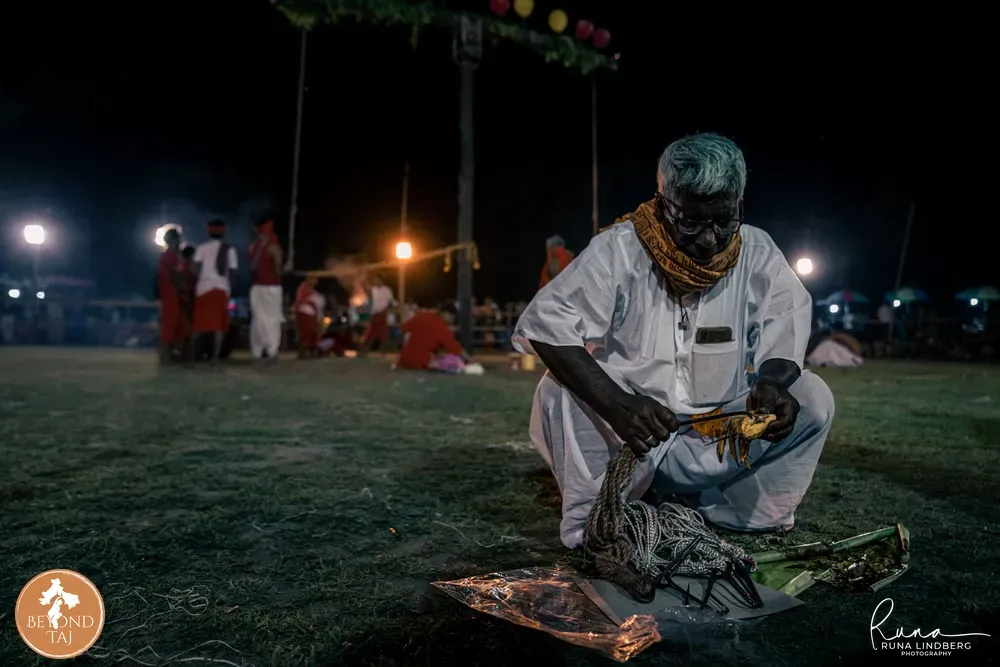
The hooks get checked before the ritual starts.
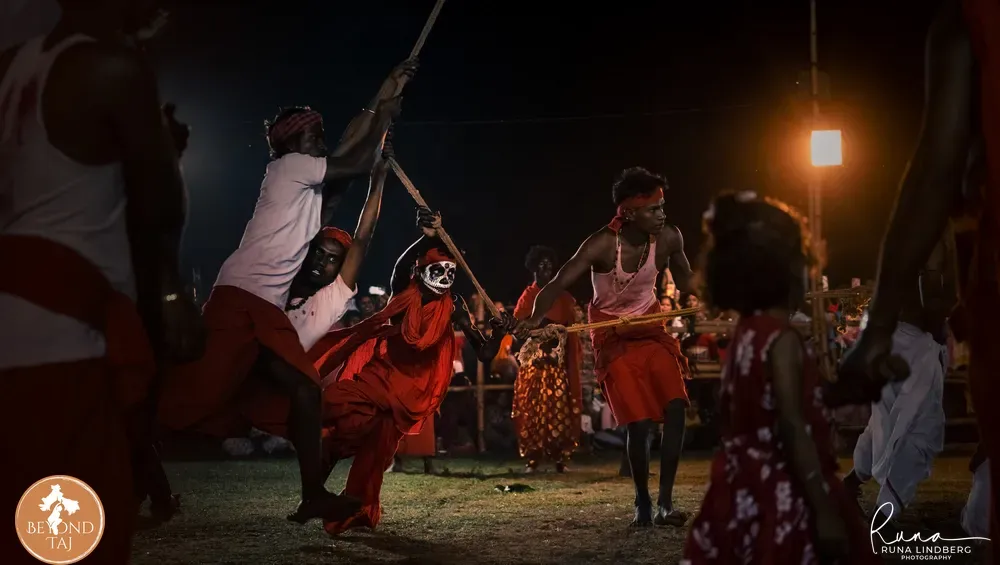
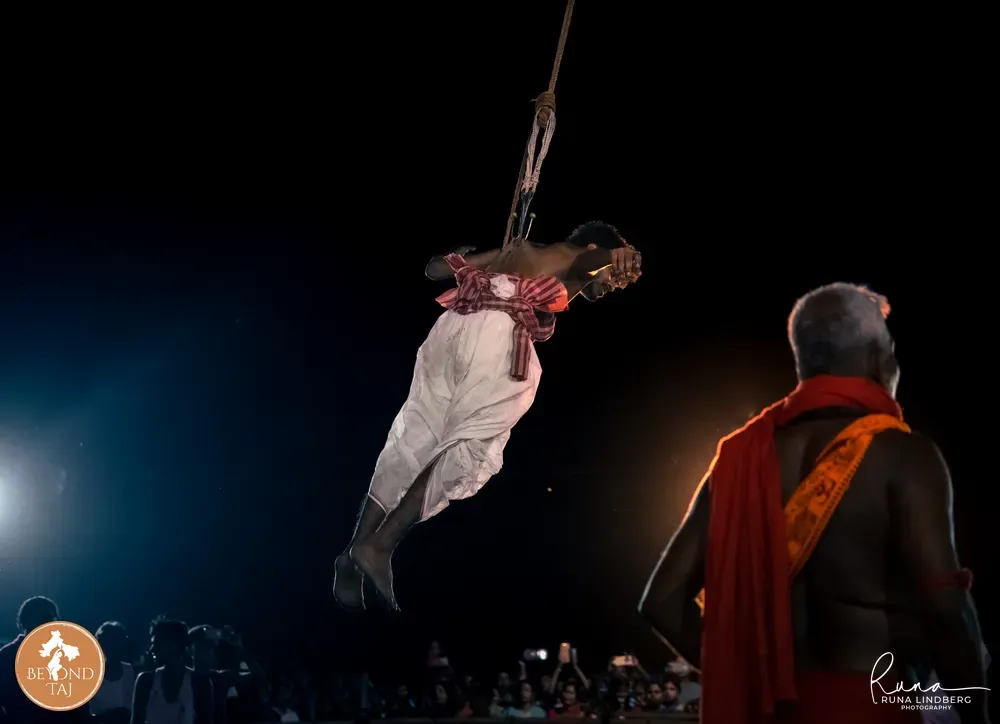
Charak Puja is the physical climax of Gajan, featuring dramatic, acrobatic penances and high-pole swinging rituals. Position yourself outside the immediate circle of active participants to safely capture the scale of the swinging structures against the open sky and gathered village crowds.
Gajan rituals do not run around the clock. Much of the daytime between morning rites and evening gatherings is unusually quiet. Use these hours to explore the wider historic core:
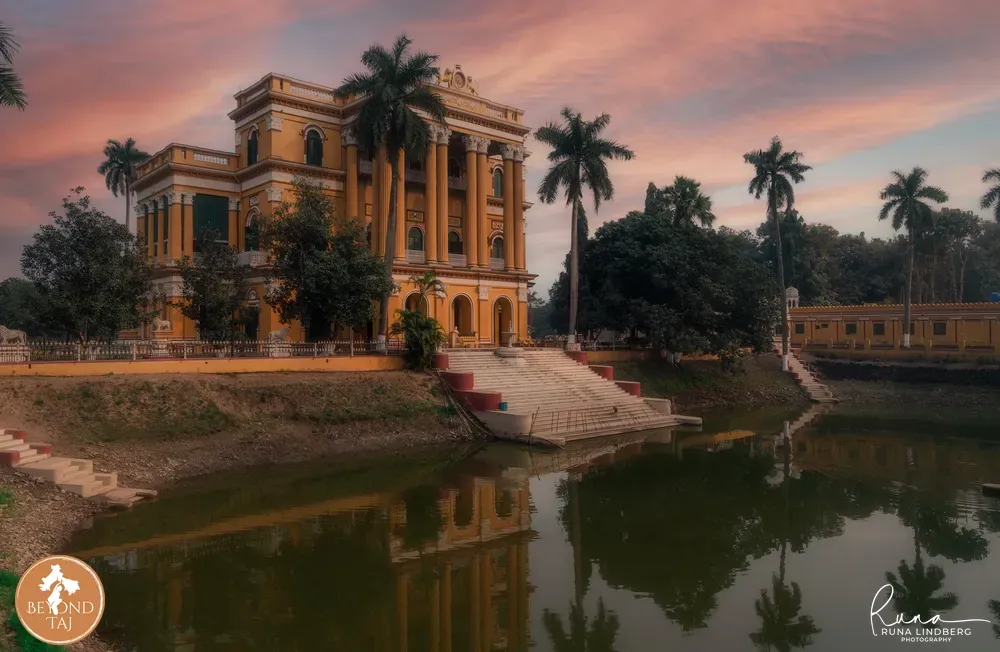
Kathgola Rajbari - on of the most impressive heritage structures of Murshidabad
The surrounding towns and villages feature old streetscapes, weathered brick facades and quiet lanes, ideal for classic street and architecture photography. You can easily balance high-intensity festival documentation with relaxed architectural wandering.
Shooting an authentic ascetic festival requires a thoughtful technical framework.
Light and timing. The most visually compelling Gajan rituals, including evening dances, fire-related devotions and atmospheric gatherings, happen during twilight, deep into the night, or during the cool hours of early dawn. Prepare your camera settings for low-light environments, and, as our own missed skull dance shows, plan your stamina as carefully as your gear.
Essential gear & technical tips:
Photography is generally permitted everywhere, in temples, during ceremonies, even, as it turned out, inside a family's own house temple. That access is built entirely on trust and courtesy, not on a blanket rule. The adoptions we describe throughout this guide, by a village head, a temple priest, a local photographer, Mr. Roy, did not happen because we walked in with cameras raised. We photographed freely once we were there, but we asked plainly, every time, what was fine to shoot and what was not, and accepted a no instantly when it came.
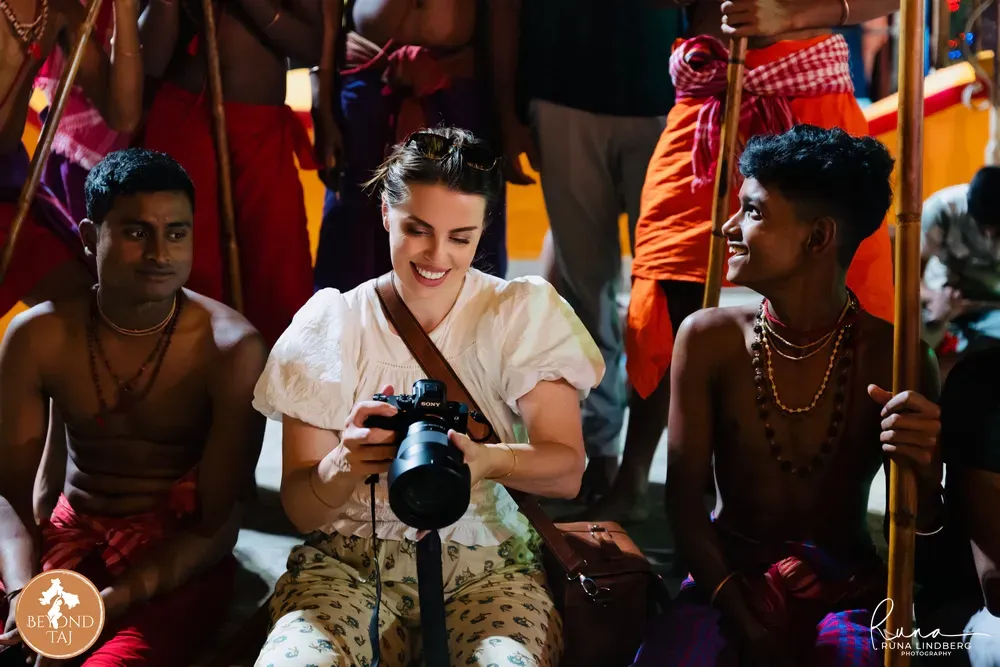
Photographer Runa Lindberg, between devotees in Kandi.
Here is our concise, battle-tested packing list for the trip:
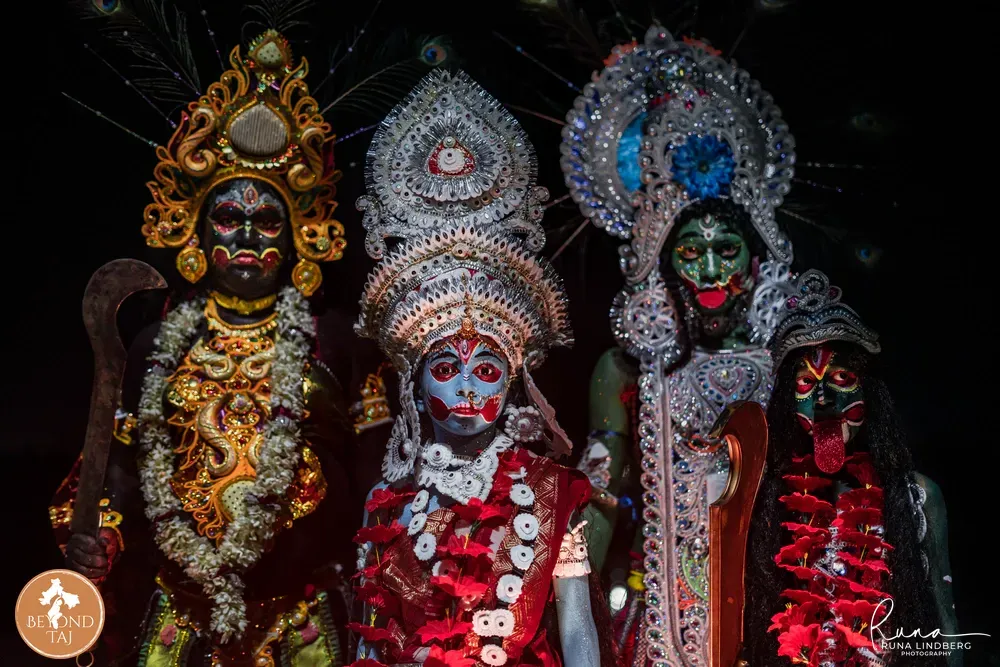
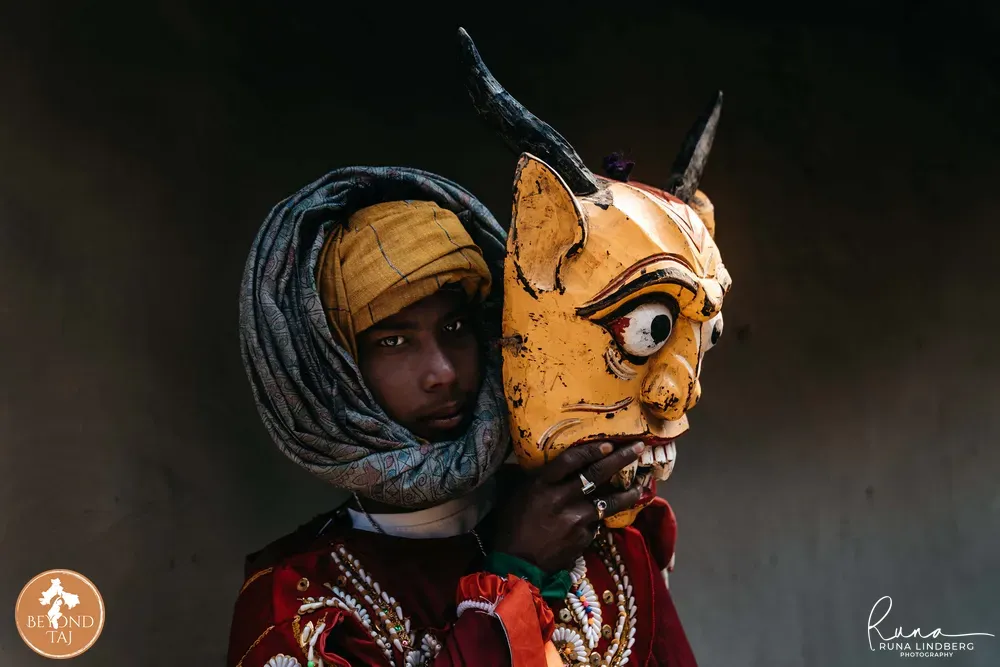
Devotees dressed as gods and demons, Murshidabad, West Bengal
★★★★★ Photography opportunities: Exceptional variety, from divine facepaintings in Gangatikuri to skull dances and body piercings in Kandi, culminating in Charak Puja in Cossimbazar. A documentary dream.
★★★★★ Vibe and atmosphere: Deeply authentic, powerful, and spiritually charged, a living tradition largely untouched by mass tourism.
★★★☆☆ Accessibility: Challenging. Spreads across multiple rural locations requiring local transport, night shooting, and cultural awareness. Pace yourself, the skull dance rewards the photographer who paces the night, not the one who pushes through it.
★★★★★ Safety and hospitality: Warm, safe local communities who took obvious pride in their traditions, and adopted two foreign photographers as guests more than once, right down to a private house-temple puja.
★★☆☆☆ Infrastructure: Basic in rural festival zones; best balanced by staying at a structured heritage base like Cossimbazar Palace.
Best for: Documentary, street, and cultural photographers seeking profound spiritual depth, traditional arts, and genuine off-the-path access.
Not ideal for: Travellers looking for polished tourist amenities, fixed schedules, or day-trip sightseeing loops.
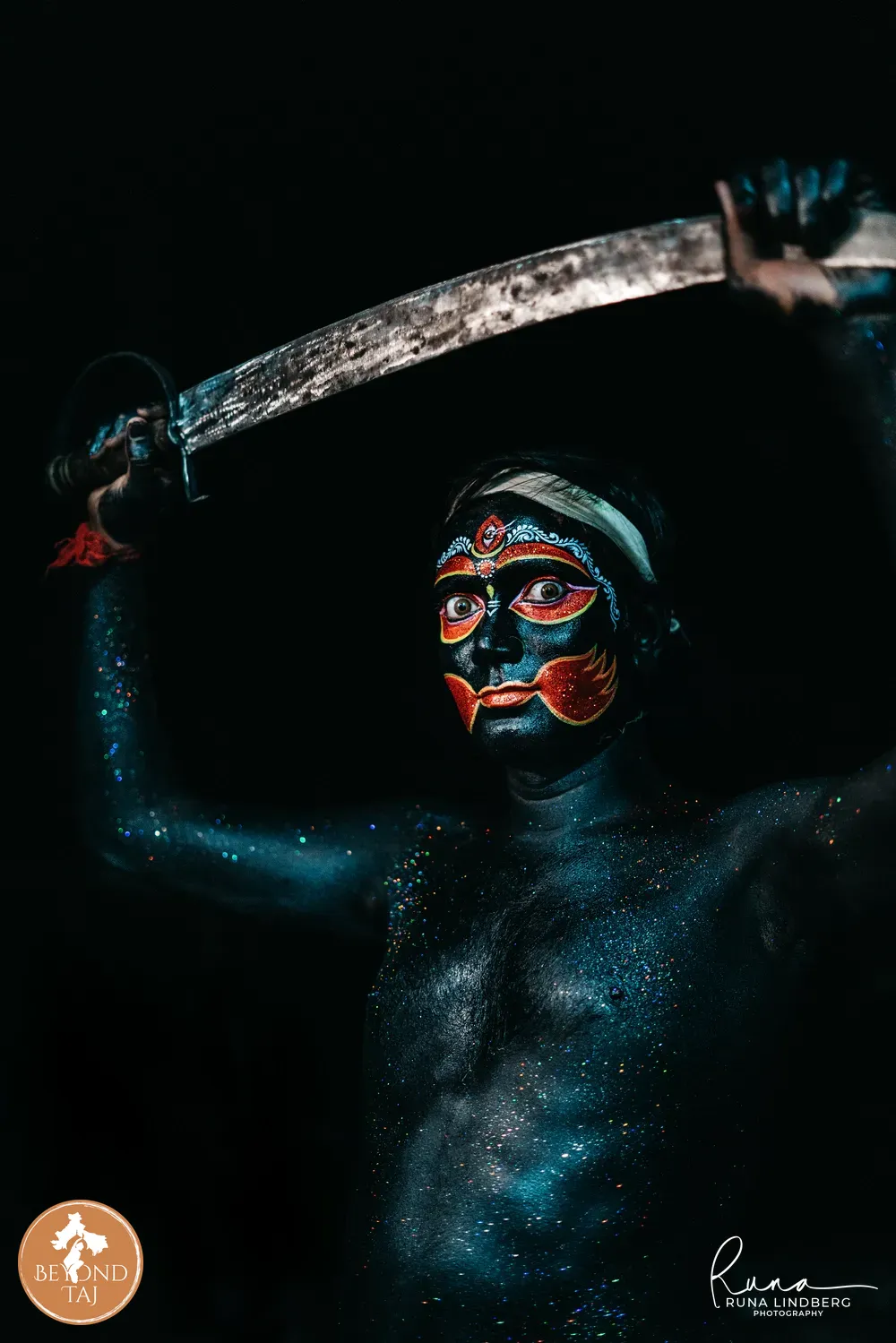
Sword raised, glitter catching what little light there is.
Yes. Despite the intense and dramatic nature of ascetic rituals like body piercing or skull dances, the atmosphere across Gangatikuri, Kandi, and Murshidabad is notably safe, welcoming, and devout. People are friendly when approached with respect.
Generally yes. Photography is widely permitted in temple courtyards, during processions, and while performers prepare, we were even welcomed into a private house temple for one puja. Always ask permission before taking close portraits, never use flash during sacred rites, and respect any boundary set by local participants.
Gajan peaks during the final days of the Bengali month of Chaitra (mid-April), coinciding with events like Charak Puja. Verifying exact local calendar dates annually is essential as specific village events shift slightly.
Yes. Booking a heritage room at the Cossimbazar Palace of the Roys provides a magnificent, atmospheric base while keeping you within comfortable driving distance of Gangatikuri, Kandi, and local festival sites.
A private car and experienced local driver are indispensable. Because Gajan events are scattered across distinct towns and rural villages like Gangatikuri and Kandi, having dedicated transport is the only practical way to follow the festival. Build in extra time for the occasional road checkpoint, particularly around state elections.
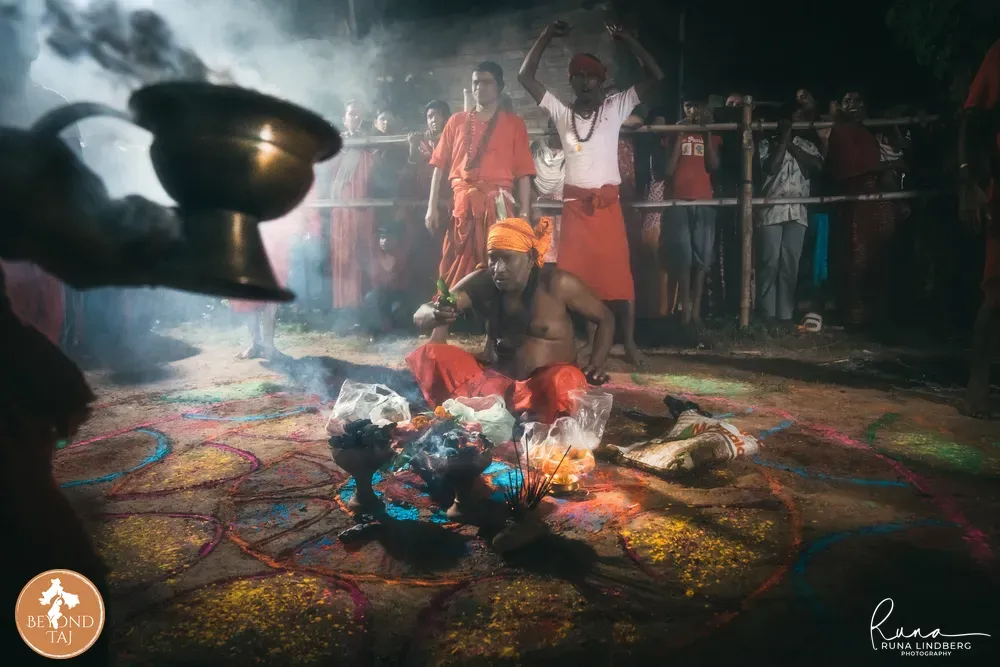
One of night ceremonies at Cossimbazar
The Gajan festival sits at the heart of an immersive photo journey designed by Beyond Taj Tours, with itineraries shaped alongside award-winning photographers who know rural West Bengal from the inside. A trip built around Gajan opens doors that are impossible to find alone, from sacred temple courtyards during peak ascetic rites to intimate access with village performers, timed precisely for the best light rather than crowds. All bookings, payments, and travel logistics are handled by our trusted travel partner. To join a small-group departure or shape a bespoke version of your own, follow the link below.
Read the itinerary → Blood & Bones Photography Tour 2027
Runa Isabel Lindberg is a writer and passionate photographer whose work has been exhibited internationally. She has been travelling through India, Nepal, Sri Lanka and Indo-China since 2008, and photography has been the thread through all of it. This blog is her personal editorial project: first-hand field notes, honest reviews of the heritage hotels she has stayed in, and photographs taken through her own lens over many return visits.
Follow her personal photography on Instagram: @runa_lindberg
Tours & bookings: The photo tours featured on this site are designed by Beyond Taj Tours, with itineraries curated together with award-winning photographers. All bookings, payments and travel arrangements are handled by our travel partner, Orange DMC, a licensed destination management company based in India.
Follow Beyond Taj Tours on Instagram: @beyondtaj.tours
© 2026 Runa Isabel Lindberg. Text and photography by the author, all rights reserved. Site and brand development by Credio Digital Media.
09 Oct 2026
28 Sep 2026
17 Sep 2026

05 Sep 2026
31 Aug 2026
15 Aug 2026
15 Jul 2026
19 Mar 2026
12 Feb 2026
15 Jan 2026
28 Dec 2025
01 Dec 2025
13 Nov 2025